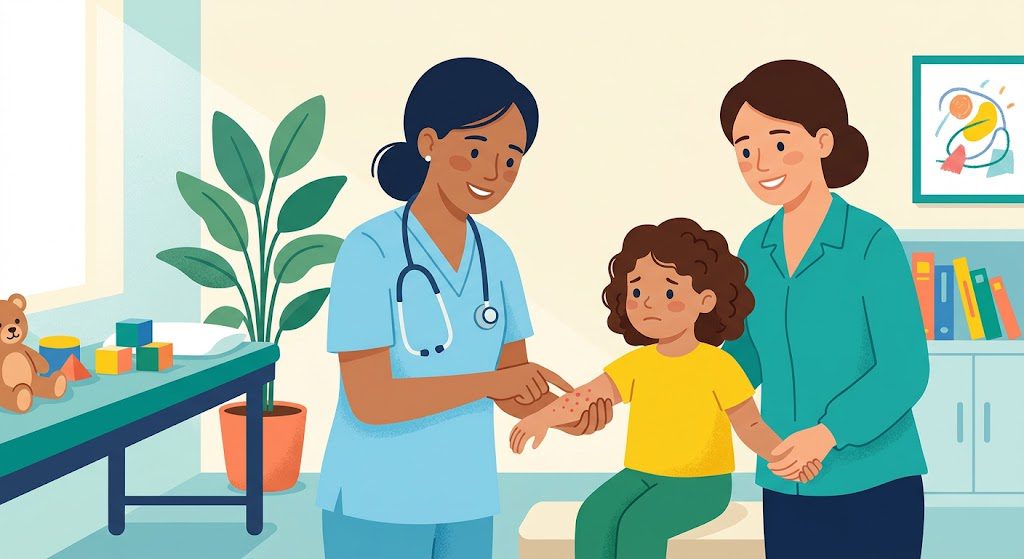
If your child has dry, itchy patches that just won’t quit — no matter how much lotion you slather on — you’re dealing with one of the most common skin conditions I see in the office: eczema, also called atopic dermatitis. It affects up to 1 in 4 children at some point, so if you’re standing in the bathroom at 9 p.m. trying to figure out which cream to use, you are far from alone.
The good news is that eczema is very manageable once you understand what’s actually going on with your child’s skin — and what isn’t. Let me walk you through what I tell families in my practice.
What Eczema Actually Is (and Isn’t)
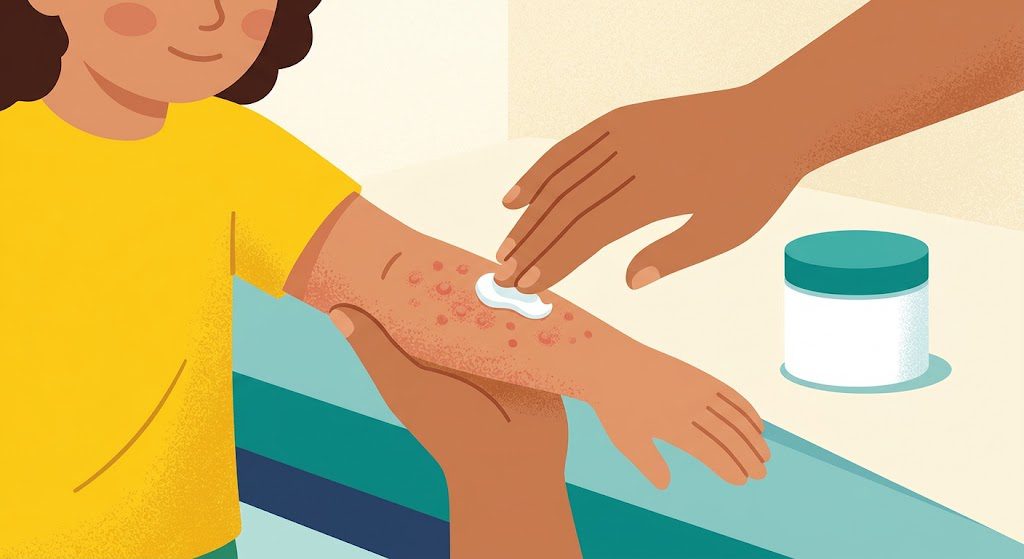
Eczema happens because a child’s skin barrier doesn’t hold onto moisture the way it should. That makes the skin dry, cracked, and easily irritated — which in turn makes it itchy, and itching leads to scratching, which can break the skin further. It’s a cycle, and the goal of treatment is to interrupt it at every point: dryness, itching, inflammation, and the infections that can follow when skin stays broken open.
One thing I want every parent to hear clearly: eczema is not contagious. It’s also not caused by something you did. The infections that sometimes show up on eczema-prone skin come from ordinary germs that live harmlessly on everyone’s skin — a child’s weaker skin barrier just has a harder time keeping them out.
Where the rash shows up often changes with age. In babies, it tends to start on the scalp, face, and cheeks — if you’re in the thick of those early months, our guide to newborn safety in the first month covers more of what’s normal and what’s not. In young school-age kids, it usually shifts to the creases of the elbows, the backs of the knees, the neck, and around the eyes.
What Tends to Set It Off
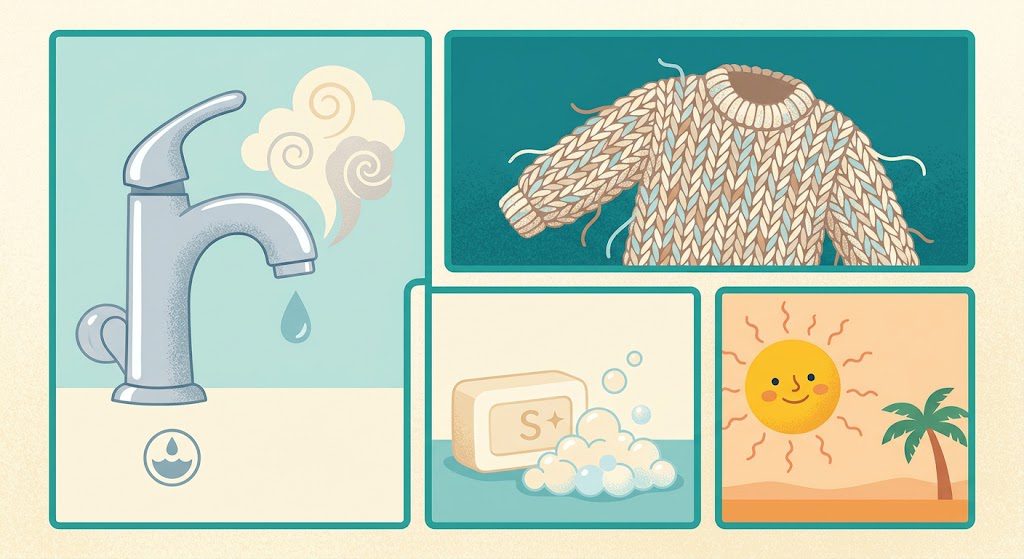
Every child’s triggers are a little different, and honestly, some flares don’t have an obvious cause at all. But a few categories come up again and again:
Hot water and long baths dry the skin out fast, and so does dry air — which describes a good chunk of the year in our corner of the Inland Empire. Sweat and overheating are common culprits too, along with harsh or fragranced soaps and rough fabrics like wool. Occasionally, certain foods play a role — though that one is more nuanced than most parents expect (more on that below).
If you notice a pattern with your own child, it’s worth mentioning at your next visit. Sometimes we’ll talk about allergy testing to help narrow things down, but that’s a conversation to have together, not something to guess at home.
The Daily Routine That Actually Moves the Needle
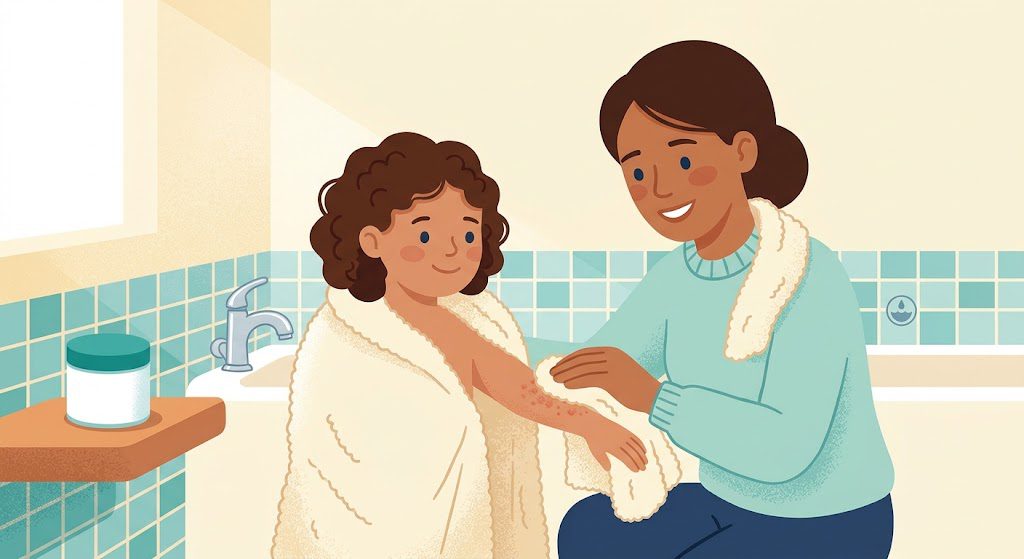
This is the part parents are usually surprised by: the single most effective eczema treatment isn’t a prescription. It’s a boring, consistent skin care routine.
According to the American Academy of Pediatrics, here’s the basic shape of it: a bath or shower every day or every other day, five to ten minutes, lukewarm — not hot — water. Skip the soap except on the sweatier spots (armpits, neck, diaper area), and when you do use a cleanser, make it a gentle, fragrance-free one. Pat the skin dry instead of rubbing it, then apply a thick, fragrance-free moisturizer right away, while the skin is still a little damp. That last part matters more than people think — locking moisture in works a lot better than trying to add it back later.
For flares that don’t respond to moisturizer alone, we’ll often add a topical steroid cream for a short, targeted period. Used correctly under a doctor’s guidance, these are safe and effective — the goal is always the lowest dose for the shortest time that gets your child’s skin back under control, not a long-term crutch.
The Biggest Myth I Hear About Eczema and Food
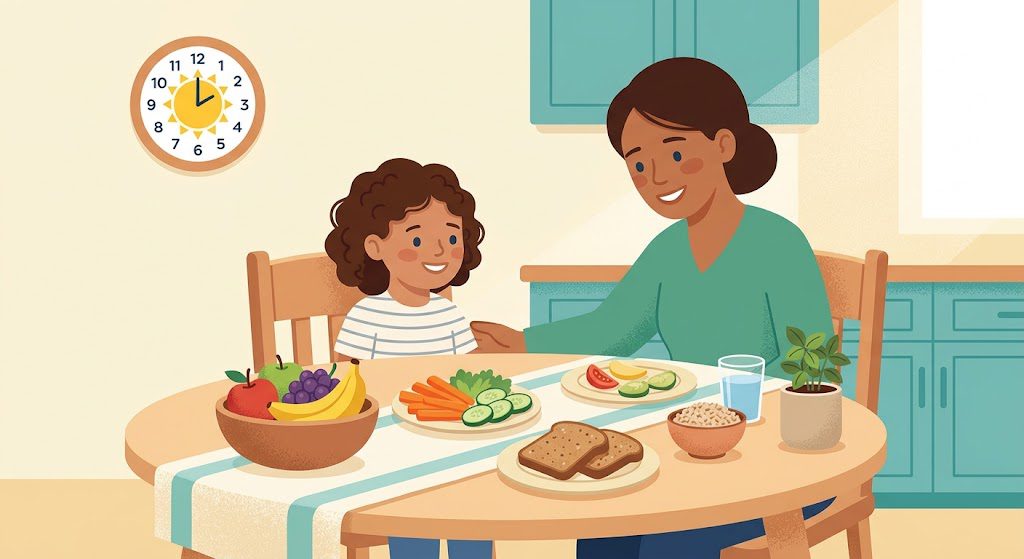
Parents often come in convinced that some specific food is causing their child’s eczema, and I understand why — when you’re desperate for an explanation, food feels like something you can control. But here’s what the American Academy of Pediatrics’s updated clinical guidance actually shows: while a meaningful share of kids with eczema (up to 40%) also develop food allergies, food itself typically doesn’t cause the eczema in the first place.
That distinction matters, because jumping straight to an elimination diet without medical guidance can backfire — kids can lose tolerance to foods they were previously fine with, turning a manageable skin issue into a bigger one. If you suspect a food connection, that’s a conversation to have with us first, not a project to start on your own.
When to Call Us
Most eczema can be managed at home with a good routine and, when needed, medication we’ve prescribed together. (For general guidance beyond eczema specifically, see our post on when to see a pediatrician.) But a few signs mean it’s time to call rather than wait:
- Increasing redness, warmth, or swelling around a patch of eczema
- Pus, yellow crusting, or oozing sores
- Red streaking spreading out from the rash
- Fever along with a worsening rash
- A rash that suddenly changes, spreads quickly, or stops responding to your usual routine
None of these mean you did anything wrong — broken, itchy skin is simply more vulnerable, and catching an infection early makes it a much easier fix.
Frequently Asked Questions
Is eczema the same as an allergy? Not exactly. Eczema, asthma, and seasonal allergies often run in the same families and are related conditions, but eczema itself is about a weakened skin barrier, not an allergic reaction on its own.
Will my child outgrow it? Many kids do improve significantly as they get older, though it’s hard to predict exactly which children will outgrow it and which will have sensitive skin into adulthood. Either way, keeping flares under control now makes a real difference in day-to-day comfort.
Can I use regular lotion instead of a special eczema cream? Thicker is generally better than thinner — creams and ointments hold moisture in longer than watery lotions. Fragrance-free matters more than any specific brand name; ask us at a visit if you’d like a recommendation for your child’s skin.
We’re Here When You Need Us
Eczema can be exhausting to manage on your own — the itching, the sleepless nights, the constant guessing about what triggered the latest flare. You don’t have to figure it out alone. If your child’s eczema isn’t responding to a good home routine, or you’re seeing any of the signs above, give us a call and we’ll get your child on a plan that actually works. Not sure who you’ll see? Meet our care team here.
Alta Loma Pediatrics | (909) 581-0008 | 10431 Lemon Ave, Suite N, Rancho Cucamonga, CA 91737
Dr. Rani Elias, MD, FAAP, is a board-certified pediatrician with over 17 years of experience serving children and families in Rancho Cucamonga and the Inland Empire. He has been recognized with a Certificate of Excellence from San Antonio Regional Hospital for his long-standing commitment to pediatric care in the community.
Disclaimer: This blog post is for informational purposes only and should not replace professional medical advice. Always consult with your pediatrician regarding your child’s health and medical care.